

Last week we looked at how a three-fold cord cannot easily be broken. This week, we’ve talked all about effective communication. What do the two have to do with each other? One can’t happen without the other.
We have to talk to and listen to God, but we also have to speak to and listen to our spouse and other people. That’s how we build connection in all relationships. When you don’t have good communication, there’s a breakdown in the relationship, and the connection is lost.
James 1:19 reminds us to “be quick to hear, slow to speak, slow to anger.” So much of our conflict comes from doing the opposite — speaking before we’ve truly listened.
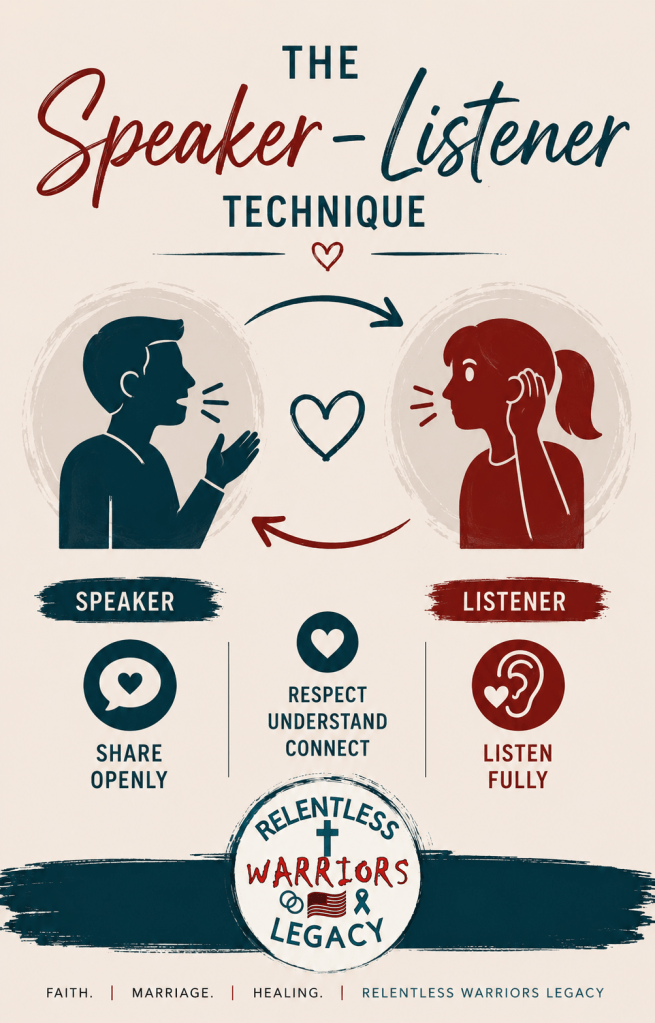
Larry and I have something that helped us put this verse into action — it worked wonders for our relationship, especially during arguments. It’s called the Speaker/Listener Technique. Here’s how it works:
You’ll need an object — a remote, a pen, or whatever’s within reach if you’re in the heat of the moment. Whoever is holding the object is the only one allowed to speak. That person is the speaker — the one with the issue, the problem, or the need to have a serious conversation. The other person becomes the listener.
The speaker’s job is to state the problem as plainly as possible, without accusing the other person. Instead of, “You hurt me, you did this to me,” try, “When you did this, it hurt me. When you said this, it made me feel this way.” That one shift moves the conversation from attack to honesty.
The listener’s job is to actually listen — eye contact, nodding, an occasional “mm-hmm.” Once the speaker is completely finished, the object gets passed to the listener.
Now the listener asks questions for understanding and clarification — summarizing or paraphrasing what they heard. Phrases like, “This is what I heard you say — is that correct?” or “I want to make sure I understood you, so is this what you meant?” work well here. The listener isn’t allowed to accuse or turn anything back on the speaker.
Once the listener has asked their questions, the object goes back to the speaker to clarify further. This can go back and forth as many times as needed, until the speaker feels fully heard and understood.
Then, the roles switch. The listener now becomes the speaker, taking the object to share their own side or perspective on the same issue — following the exact same process. This way, both people get to be fully heard, not just one.
Through all of it, both people have to avoid gaslighting the other person or downplaying the seriousness of their feelings. And if voices start to rise or emotions run too high, that’s your cue to call a timeout — state that you need it, say how long you need, and revisit the conversation within 24 hours.
This technique takes practice — it does not come easy at first. It took Larry and me a good six months of practicing this technique, object in hand, to fully grasp it. So practice is necessary, and it has to be intentional.
Communication isn’t about winning. It’s about listening first — so you can truly understand each other.
This week, we challenge you to try the Speaker/Listener Technique with your spouse. Grab an object, pick a topic — big or small — and practice it together. You might be surprised at how much more you actually hear each other.
For more information, please check out our social media on Facebook and Instagram under Relentless Warriors Legacy. You can also email us at relentlesswarriorslegacy@gmail.com — we would love to hear from you! We hope you have a wonderful week ahead. ❤️🩵🙏
 Relentless Warrior's Legacy