Four or five years ago, when Larry and I were still at our worst, we were fighting daily. I was still living in the hurt of his triggers and actions because they kept coming up over and over again — it had become a pattern with him. We were in counseling together, trying to put the communication tools in place as much as we were capable of at the time.
One night we were arguing, and I was so tired of feeling hurt and sad. I left our bedroom and started praying to God. Forgiveness is what kept coming to my mind. God wanted me to find forgiveness for Larry. I kept telling God that Larry hadn’t asked for forgiveness — how was I supposed to give it to him? God told me that forgiveness was for me, not Larry.
When I walked back into our bedroom, Larry started in again. I finally looked at him with tears in my eyes and told him that I forgave him for all the things he would never ask forgiveness for. That there were so many things he had done to hurt me, and he would never understand how much strength it took me to forgive him and say those words.
That kind of forgiveness was one of the hardest things I have ever done. It was also the most freeing. I released all the hurt and anger I was carrying for Larry. I was choosing my own peace.
But after that, I set some boundaries with him. I was not going to tolerate angry outbursts at home. If he wouldn’t use the tools we’d been given in counseling, I wasn’t going to have conversations with him in that moment. He had to be present with me and our boys. We set limits around his phone and his time away from home.
While I had forgiven Larry, I did not forget the things that led us to so much trouble in our marriage. We were no longer walking on eggshells for him. I didn’t pretend nothing happened, and I still don’t. I don’t ignore red flags when they come up. If any PTSD symptoms or triggers surface, I tell him right away, before they become a bigger problem.
It has been several years, and I have not removed those boundaries. I won’t. At first, Larry wasn’t receptive to them — but over time, he started looking at things through my eyes.
I hope this glimpse into our lives helps you see the difference between forgiveness and forgetting. Just because you forgive doesn’t mean you have to forget everything that happened. Even in extreme cases of abuse, forgiveness is possible and needed, but strong boundaries have to be kept. Forgiveness is not the same as staying in an abusive relationship — please do not stay if your life is at risk.
Today, ask yourself: is there a boundary you need to set, or one you need to hold onto more firmly? Forgiveness and boundaries can live together — give yourself permission to keep both.
❤️🩵
Follow along and connect with us on Facebook and Instagram, or reach out anytime at relentlesswarriorslegacy@gmail.com. We’d love to hear from you.
Watch Larry and me sit down for a candid Q&A about the Awareness Wheel — how we discovered it, the hard truth about what our marriage used to look like, and how this one tool helped us go from constant conflict to real, connected conversations. Grab a cup of coffee and join us for a conversation straight from the heart.
For more information, please check out our social media on Facebook and Instagram under Relentless Warriors Legacy. You can also email us at relentlesswarriorslegacy@gmail.com — we would love to hear from you! We hope you have a wonderful week ahead. ❤️🩵🙏
Last week we looked at how a three-fold cord cannot easily be broken. This week, we’ve talked all about effective communication. What do the two have to do with each other? One can’t happen without the other.
We have to talk to and listen to God, but we also have to speak to and listen to our spouse and other people. That’s how we build connection in all relationships. When you don’t have good communication, there’s a breakdown in the relationship, and the connection is lost.
James 1:19 reminds us to “be quick to hear, slow to speak, slow to anger.” So much of our conflict comes from doing the opposite — speaking before we’ve truly listened.
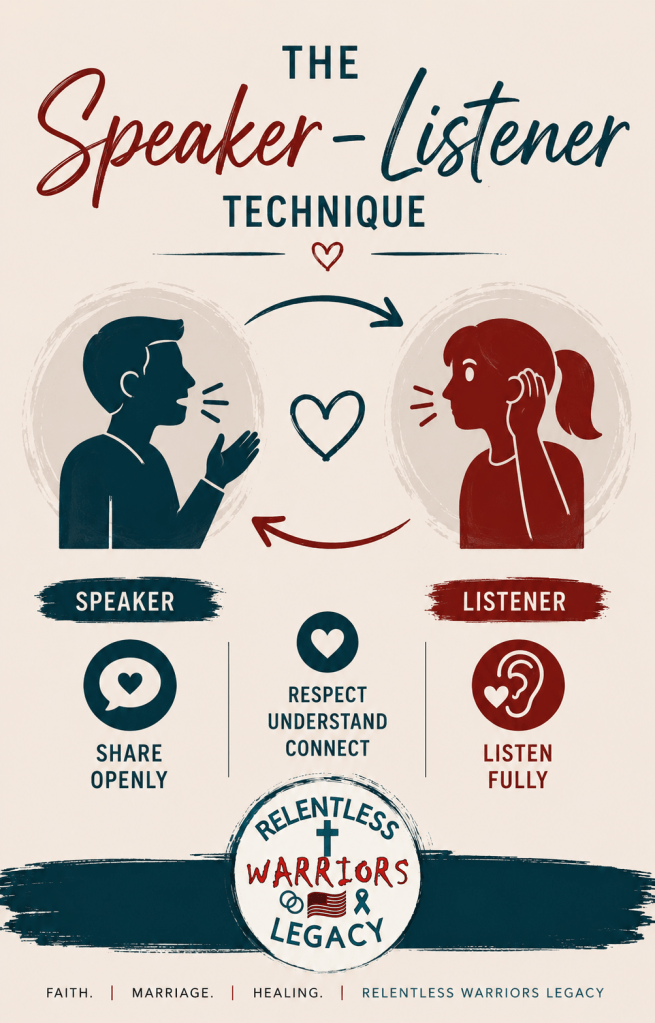
Larry and I have something that helped us put this verse into action — it worked wonders for our relationship, especially during arguments. It’s called the Speaker/Listener Technique. Here’s how it works:
You’ll need an object — a remote, a pen, or whatever’s within reach if you’re in the heat of the moment. Whoever is holding the object is the only one allowed to speak. That person is the speaker — the one with the issue, the problem, or the need to have a serious conversation. The other person becomes the listener.
The speaker’s job is to state the problem as plainly as possible, without accusing the other person. Instead of, “You hurt me, you did this to me,” try, “When you did this, it hurt me. When you said this, it made me feel this way.” That one shift moves the conversation from attack to honesty.
The listener’s job is to actually listen — eye contact, nodding, an occasional “mm-hmm.” Once the speaker is completely finished, the object gets passed to the listener.
Now the listener asks questions for understanding and clarification — summarizing or paraphrasing what they heard. Phrases like, “This is what I heard you say — is that correct?” or “I want to make sure I understood you, so is this what you meant?” work well here. The listener isn’t allowed to accuse or turn anything back on the speaker.
Once the listener has asked their questions, the object goes back to the speaker to clarify further. This can go back and forth as many times as needed, until the speaker feels fully heard and understood.
Then, the roles switch. The listener now becomes the speaker, taking the object to share their own side or perspective on the same issue — following the exact same process. This way, both people get to be fully heard, not just one.
Through all of it, both people have to avoid gaslighting the other person or downplaying the seriousness of their feelings. And if voices start to rise or emotions run too high, that’s your cue to call a timeout — state that you need it, say how long you need, and revisit the conversation within 24 hours.
This technique takes practice — it does not come easy at first. It took Larry and me a good six months of practicing this technique, object in hand, to fully grasp it. So practice is necessary, and it has to be intentional.
Communication isn’t about winning. It’s about listening first — so you can truly understand each other.
This week, we challenge you to try the Speaker/Listener Technique with your spouse. Grab an object, pick a topic — big or small — and practice it together. You might be surprised at how much more you actually hear each other.
For more information, please check out our social media on Facebook and Instagram under Relentless Warriors Legacy. You can also email us at relentlesswarriorslegacy@gmail.com — we would love to hear from you! We hope you have a wonderful week ahead. ❤️🩵🙏
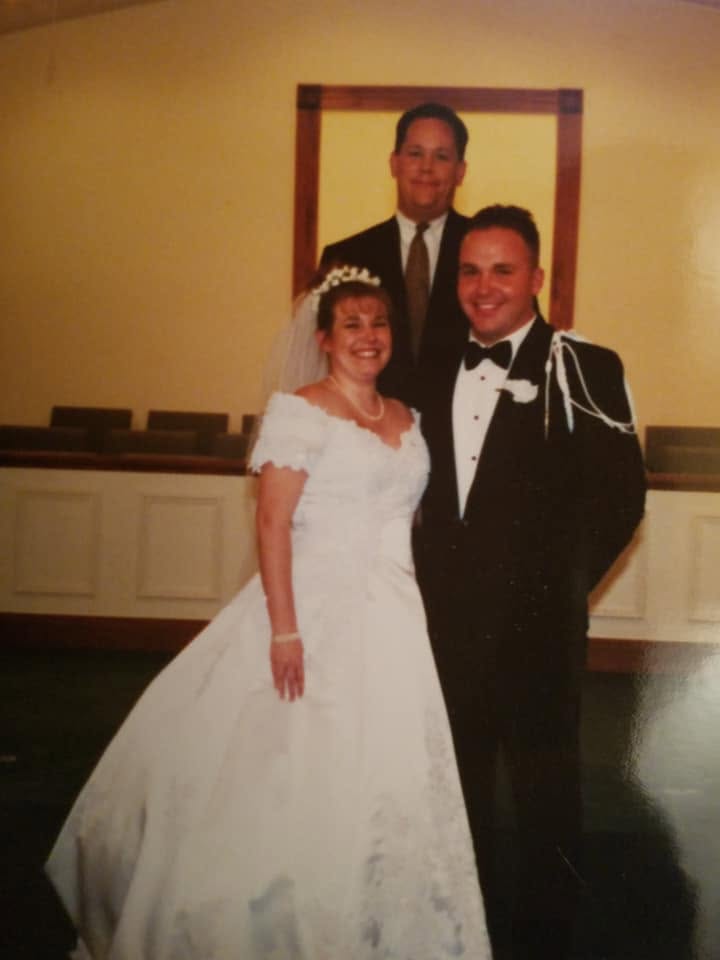
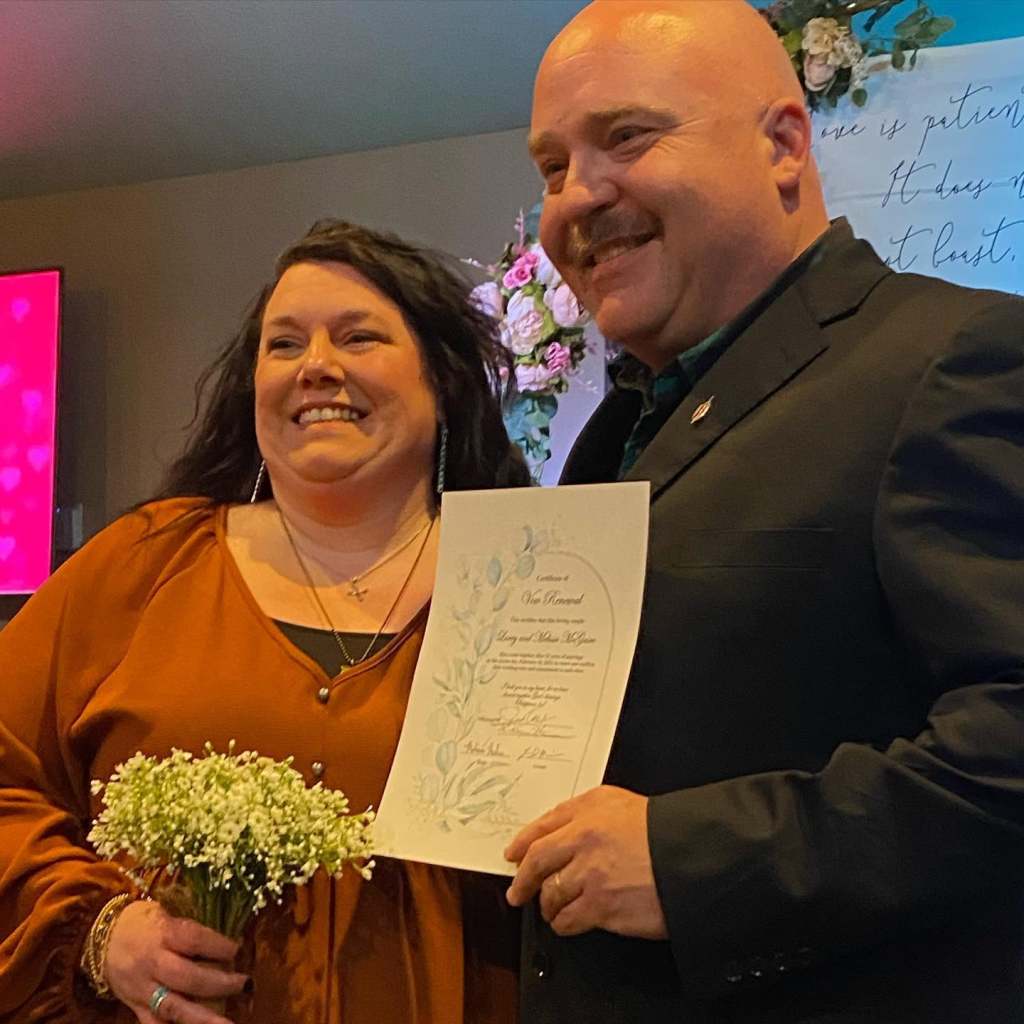
This picture was taken almost 25 years ago. Hard to believe. We were just kids when we said “I do” for the first time. As you can see, yes, we are in a church — but we had no idea what it truly meant to take our vows in front of God and put Him at the center of our marriage. Around four or five years later, God began to show us exactly what that meant. This is our story of the three fold cord and the power of what that cord can do.
The First Time God Showed Up
We were in our first church and our marriage was struggling. We were so very close to divorce. One Sunday night, during an amazing service, one of the sweetest ladies in our church prayed over us. Her name was Joyce.
To give you a little context — Joyce could hardly walk. She used a wheeled walker to get to her pew every Sunday and even that was a struggle. But Joyce loved the Lord with everything she had and never missed a single service. She was one of the most strong and faithful women I have ever known.
That night, something happened that I will never forget. Joyce walked to the altar completely on her own — no walker, no assistance — and she placed Larry and me on our knees facing each other. We were both already crying. I thought what was happening was already extraordinary, but it was only just beginning.
Joyce started walking circles around us, binding Larry and me together with a cord. At the time I did not fully understand what she was doing. I did not realize she was binding us together with the three-fold cord. She made several circles around us that night, binding us together as strong as she possibly could.
It was one of the first times I ever watched God move over Larry and me — and it was absolutely mind blowing.
The Day God Finished What He Started
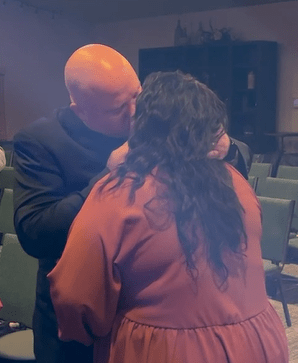
Fast forward to February 2023. Larry and I were at the Dave Roever marriage retreat and we had the opportunity to renew our wedding vows. A few other couples renewed their vows alongside us that day. When they asked us to face our spouses, Larry and I turned toward each other and grabbed hands.
What happened next is something I will spend the rest of my life trying to find the right words for.
The moment our hands touched, I saw a white light drop from the ceiling and fall straight down between us — and then it completely engulfed Larry and me. Then I saw a gold cord begin wrapping around us. It kept going the entire time Larry and I stood there facing each other saying our vows. All I could do was cry and watch in absolute amazement at what God was doing right there between us.
For the first time, we had God at the center of our marriage — literally. I watched God bind us together again with the three-fold cord, just as He had all those years before through Joyce. It was one of the most beautiful days of our entire marriage and one of the most extraordinary things I have ever witnessed God do.
A cord of three strands is not quickly broken. ❤️
Ecclesiastes 4:12
For more information, please check out our social media on Facebook and Instagram under Relentless Warriors Legacy. You can also email us at relentlesswarriorslegacy@gmail.com — we would love to hear from you! We hope you have a wonderful week ahead. ❤️🩵🙏
Trauma Responses — A Look Inside the McGuire Household
I don’t know about you, but it has been a really long week here in the McGuire household. Between work, baseball, planning a trip to Ohio, trying to buy a new car, and making sure my son has a reliable car too — things have been absolutely hectic. And honestly? This is exactly where our trauma responses like to creep in.
Larry and I react very differently when we are stressed and triggered. His response is normally anger, and mine is withdrawal and shutdown. And right now, I can see both of us sitting very deep in our trauma responses. I have been absolutely exhausted — taking naps every single day when I get home from work because I just cannot seem to function. Larry has been coming home exhausted too, but his exhaustion turns into anger really fast. And as any parent knows, that is not a great combination when you have children in the house.
But here is something I want you to notice — our trauma responses are not the same. And that is because our experiences, our personalities, and the way God made us are not the same. Even our children have their own trauma responses that look completely different from ours.
So let’s dive deep into that today. Let’s talk about what trauma responses actually look like inside our family, because I think a lot of you will see yourselves here.
Me — Fight and Flight
I can react in two different ways — fight or flight. I very rarely freeze.
When I go into fight mode, it looks like yelling and grabbing for control. I also carry a lot of physical tension in my neck and shoulders, which is my body’s way of telling me I am triggered before my mind even catches up. Then there are the times I hit flight mode, because I simply do not want to deal with it. I don’t feel like I have the mental capacity to handle what is in front of me, so I will avoid conflict at all costs and try to emotionally check out completely.
Larry — Fight and Freeze
Larry’s response is mainly fight, but every once in a while he will freeze.
He gets irritated very easily and becomes defensive quickly, wanting to grasp for control. He also struggles with physical tension and a tendency to place blame. But if things get to be too much, he will go completely numb — get very quiet and withdraw immediately. It is like a switch flips and he is just gone emotionally.
Our Boys — Freeze, Flight, and Fawn
Our boys mostly freeze and sometimes go into flight, but the most common thing you will see from them is that they get quiet, go numb, and withdraw. They do this because they just want everyone to stop. They want the house to be calm and the noise to go away.
They also exhibit what is known as the fawn response — meaning they will try to please us, try to keep the peace, and try to make themselves as agreeable as possible just so the tension in the house dies down. They learned that if they could just make us happy, things would get quiet.
None of these are healthy ways to respond. Not one of them. And I say that with a full heart, because I know exactly how we got here.
How We Got Here
For a very long time, our home was driven by PTSD and all of the trauma responses that came with it. The one thing our home did not have was grace. We did not extend grace to each other, we did not extend grace to our children, and honestly, we did not extend grace to ourselves either.
Because of that, we grew very far apart from one another. There was no compassion. There was no patience. And that broke the connections between each of us in ways that took years to repair.
It took Larry and I going to counseling and really digging deep into ourselves to understand that we had to change. We could not keep blowing up and saying “I’m sorry” over and over again, because that had become nothing more than lip service. Real change meant going after the actual behaviors. It meant learning to pause, becoming self aware, and growing our emotional intelligence — even when that was incredibly hard and uncomfortable.
We do that now by labeling our emotions, recognizing when a trigger has happened, and pulling ourselves away from our family when we are in the middle of a reaction so that they are not on the receiving end of it.
I will be honest with you — all of this has taken us years. We did not get here overnight, and we are still not done. But without God, and without Him showing us in a very real and biblical way what it looks like to change and grow as parents and as partners, none of this would have ever happened for us.
There Is Always Hope
We still have trauma responses. Larry still has them. I still have them. Our kids still have them. But we are working every single day to be better — better for each other, better for our boys, and better for the people God has called us to serve through this ministry.
If your home looks anything like ours did, please hear me when I say this — there is always hope. God is always with you. He does not ask you to be perfect. He just asks you to take one step at a time, and He will walk every single one of those steps right alongside you. 🙏💛
For more information, please check out our social media on Facebook and Instagram under Relentless Warriors Legacy. You can also email us at relentlesswarriorslegacy@gmail.com — we would love to hear from you! We hope you have a wonderful week ahead. ❤️🩵🙏
This week’s post is going to be a little different.
Throughout the week, we’ve talked about PTSD triggers, what they are, and how they work. If you’ve been following along on our social media, you’ve seen some of those discussions. Here on the blog, I want to share our personal experience with PTSD triggers and what they did to our marriage and family.
Larry and I have dealt with PTSD triggers for most of our marriage. The hardest part is that for nearly ten years, we didn’t even know that was what was happening. We had no idea what a trigger was, why we reacted the way we did, or how to fight back against it.
What we eventually learned was that we both had PTSD, but our triggers looked very different.
Larry’s triggers include loud noises, children (whether they are happy or upset), certain BBQ smells, crowds, prop planes, and some medical scenes. When he was triggered, it could lead to extreme anger, panic attacks, sleepless nights from night terrors, withdrawal, isolation, and hiding in distractions like his phone, hunting, fishing, or riding his motorcycle.
My biggest triggers are certain time periods throughout the year. The anniversaries of losing my parents and our twins, along with certain holidays, can hit me hard. When I am triggered, I experience extreme exhaustion, anger, insomnia, mood swings, and sometimes struggle to complete even basic tasks around the house.
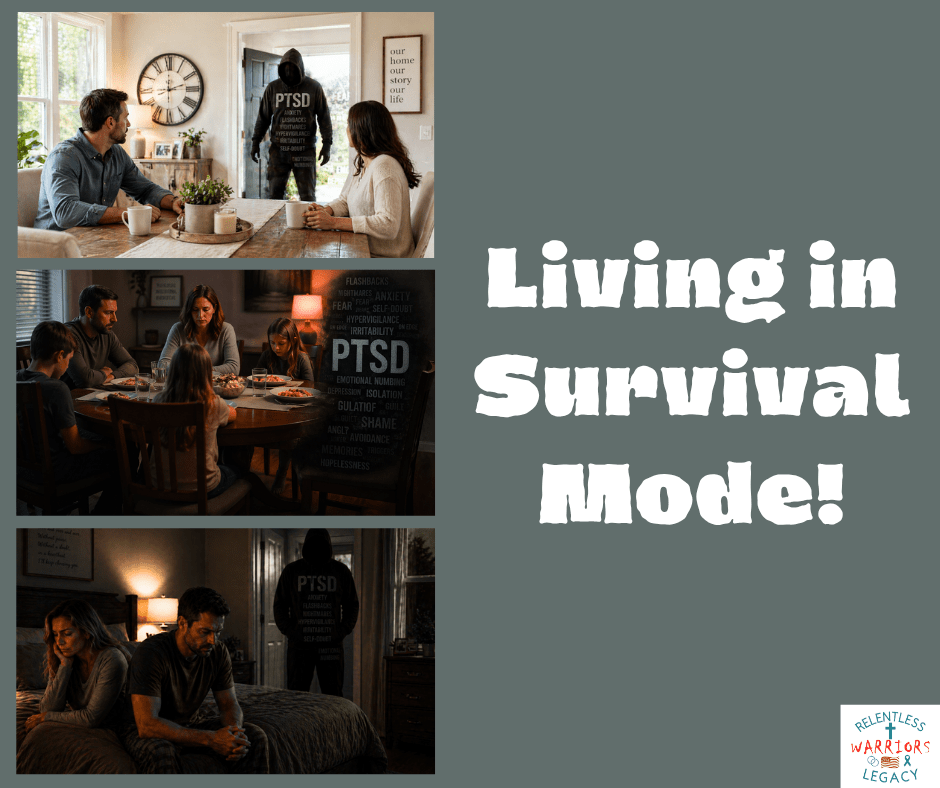
For years, we lived in survival mode because of our triggers.
The triggers became our identity.
Our boys were living in survival mode too. They didn’t want to go out in public with us because they never knew what might happen. Larry could be triggered in public, and none of us knew when it was coming. Sometimes we avoided events altogether because one of us simply couldn’t handle them emotionally or physically.
Looking back now, I can see that PTSD wasn’t just affecting Larry and me. It was affecting our entire family.
One day, Larry was triggered, and things reached a point where I could no longer calm him down. I was exhausted. I was scared. I was done.
I took our boys and left.
I told Larry that I would not bring them home until he got help for his anger.
That day became a turning point in our story.
Larry started anger management and began learning what his triggers were and how to recognize them before they took over. He started processing some of the traumatic events he had carried for years. He also learned something important: just because a trigger doesn’t show up for a while doesn’t mean it’s gone.
Triggers don’t disappear simply because they have been quiet for a season.
Not long after Larry started counseling, I joined him for marriage counseling. It didn’t take long before I was diagnosed with PTSD as well. My triggers looked different, but they were just as destructive. Instead of exploding outwardly, I would sink into deep depression.
I had to learn how to recognize when I was being triggered and slowly fight my way back out.
The reality is that when two people are battling PTSD triggers inside the same marriage, things can become hopeless very quickly.
Triggers don’t just disappear.
Trust doesn’t magically rebuild itself.
Communication doesn’t automatically improve.
Those things have to be fought for.
This is what almost ended our marriage.
I was tired of the triggers. I was tired of what they were doing to our boys. Our children were becoming triggered too. They would withdraw, isolate themselves, drop their heads during conversations, and walk on eggshells around us.
Our family was broken into so many pieces that I couldn’t imagine how they could ever fit back together.
We felt completely alone.
But God never left us there.
One of the verses that carried us through those years was Psalm 23:4:
“Even though I walk through the darkest valley, I will fear no evil, for You are with me.”
God was walking through every trigger with us, even when we couldn’t see Him. As Larry and I began reaching for healing and trying to put the broken pieces of our lives back together, God provided the tools we needed to fight back against the triggers that had controlled us for so long.
He didn’t just walk with Larry and me. He walked with our boys too.
For so many years, our lives felt hopeless. We were frustrated, exhausted, and scared. We spent so much time reacting to triggers that we forgot what it felt like to truly live.
But God.
He walked with us through every trigger, every setback, every argument, and every painful memory. When we felt weak, He gave us strength. When we felt hopeless, He reminded us that He wasn’t finished with our story.
He strengthened our boys when they were hurting. He restored hope in Larry. He restored hope in me. He began restoring our marriage.
And He is still restoring our family today.
The healing didn’t happen overnight. Learning our triggers didn’t magically make them disappear. We still have triggers. We still have hard days. We still have moments when PTSD tries to pull us back into survival mode.
The difference is that PTSD no longer controls our lives.
Today, when triggers come, we have tools. We have awareness. We have communication. Most importantly, we have God.
Triggers no longer rule us.
We rule them.
Not because we are strong enough on our own, but because we are no longer fighting alone.
If PTSD has affected your marriage or your family, please hear this: there is hope. Healing is possible. It takes work, patience, and time, but God can restore what trauma has tried to destroy.
Keep walking.
The valley is not your destination.
And God is walking with you every step of the way.
For any questions, please reach out to Larry and me at relentlesswarriorslegacy@gmail.com
Also check out our Facebook and Instagram for more information on triggers.
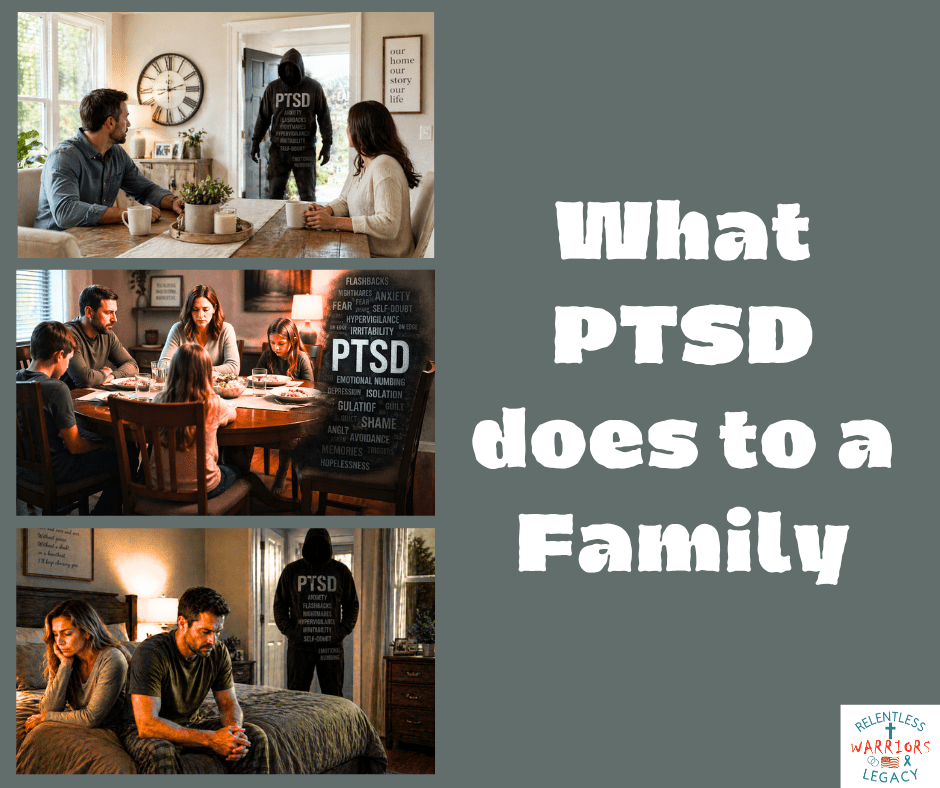
I will have to admit, at first, I did not see the effects PTSD was having on my family. It crept in like a thief in the night, slowly stealing from our marriage, our children, and the peace in our home.
Looking back now, I can clearly see how PTSD touched every part of our lives. I can see the damage it caused in our marriage, the tension it created in our home, and the weight our children carried while living in the middle of it all.
What hurts the most is realizing that even though the battle belonged to PTSD, the entire family was fighting the effects of it. And even now, I can still see some of the things our children carry with them from growing up in a home overshadowed by trauma.
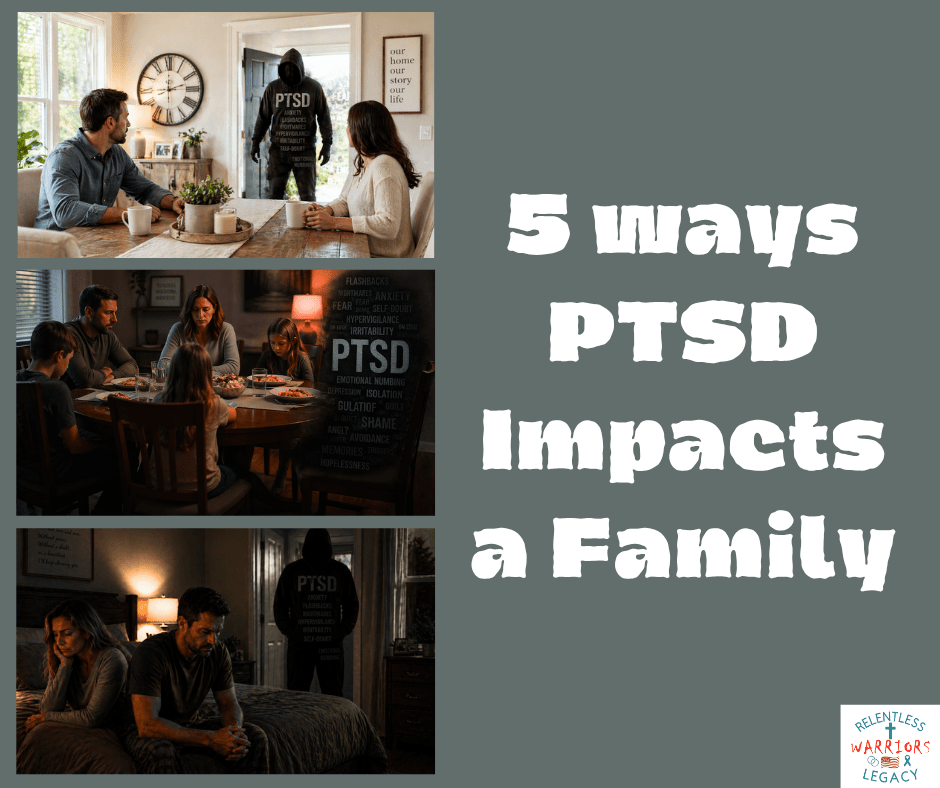
There are several ways PTSD can impact a family. We are going to look at five of the major areas that were affected in our home.
1.) Complete Breakdown in Communication One thing I often say about PTSD is that it steals your ability to communicate. In our home, there was more yelling than talking. Larry would avoid us at all costs, and it felt like none of us had the right words to talk to each other or even to our children. Conversations turned into arguments, silence, or complete shutdown.
2.) Reactive Behavior Larry and I both became extremely reactive in our behavior. The smallest thing could set either of us off. His anger became uncontrollable at times, and that anger spilled out everywhere. He would explode in public, and the kids and I were often embarrassed and overwhelmed by his reactions. Our home constantly felt like it was one step away from chaos.
3.) Breakdown in Trust Because of the constant reactive behavior, trust began to break down in our family. I did not trust Larry, and our children stopped trusting us as their parents. When a home no longer feels emotionally safe, trust begins to disappear. Even today, rebuilding that trust with our children is something Larry and I are still working through.
4.) Secondary Trauma This was something that took years for Larry and me to recognize. We could not fully see the effects PTSD was having on our children until we began learning about trauma in counseling. Our children were living in survival mode just like we were. They were carrying stress, fear, and emotional weight that children were never meant to carry.
5.) Chronic Stress With everything happening in our home, chronic stress became normal for all of us. There was a constant heaviness and tension in the atmosphere. The kids did not know how to process what they were feeling, and Larry and I could not figure out how to get out of fight-or-flight mode. Our home felt like it was constantly at a boiling point, always ready to spill over.
When Larry and I were both in the trenches with PTSD, our entire house lived in survival mode. The kids would tiptoe around us, trying not to set either of us off. Larry and I would scream at each other, and at times, we would scream at the kids too. We were highly reactive, and our home often felt unpredictable.
That environment led our two oldest sons to shut down emotionally. They developed their own form of survival mode.
Survival mode can look different depending on the person. My survival mode looked like shutting down, sleeping too much, overeating, neglecting my own well-being, and trying to protect our boys—or at least what I thought was protecting them.
For our kids, survival mode looked different. It meant hiding in their rooms, throwing themselves into sports or video games, avoiding public situations, and constantly watching what they said and did to make sure they did not upset Larry or me. They were always reading the room, trying to stay one step ahead of the next explosion.
Please understand something important: that was never their responsibility.
Children should never have to change who they are in order to protect themselves from a parent’s explosive behavior. They should never feel responsible for managing the emotions of the adults around them. It was never our children’s job to keep the peace in our home, and it is never the child’s fault when they find themselves living in survival mode.
God did not place children on this earth to serve their parents. He entrusted children to parents as a gift. Our responsibility as parents is to love them, cherish them, protect them, and help them grow into the people God created them to be. When trauma enters a home, that purpose can become blurred, but it never changes God’s design.
I think our verse for this week really speaks to the overwhelming love of God. He walks with us through the hard times. He was with Larry and me through all the arguments, and He was with our children as they lived in an explosive home.
Every aspect of our home was broken. Larry and I were on the verge of divorce. Our marriage needed healing. Our children needed healing. Our home needed healing.
That is where God stepped in and began to slowly change everything.
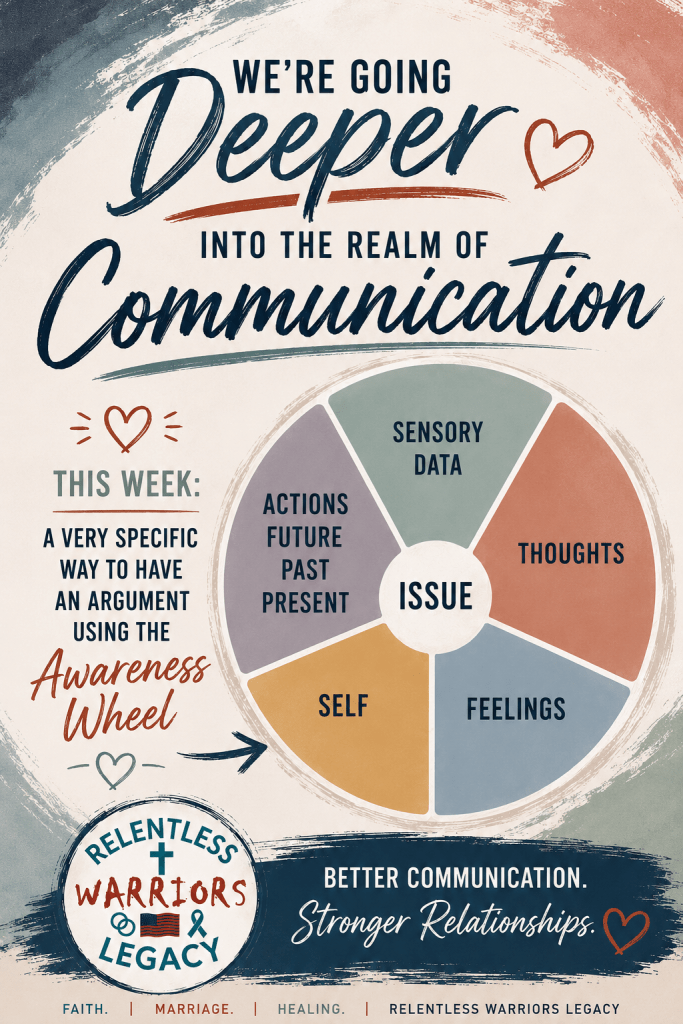
God brought us a counselor who gave us practical tools to help us navigate PTSD and its effects on our family. Larry learned to use an emotion wheel to identify and label what he was feeling instead of immediately reacting in anger. I began to understand what God’s love truly looks like and how to extend that love to others, even during difficult moments.
God taught us simple but powerful skills. We learned that something as simple as counting to ten can slow down our reactions and keep us from automatically yelling. We learned the timeout rule, where one of us can say we need to walk away from an argument, but we must also set a time to come back and continue the conversation. That one rule alone has saved us from countless hurtful words.
One of the biggest things God taught me was that Larry is God’s son just as much as I am God’s daughter. That realization changed the way I viewed him. Instead of seeing him as my enemy, I began to see him through God’s eyes. It made me want to treat him with love and respect rather than respond with yelling and anger.
None of these changes happened overnight. Learning to regulate emotions is hard work. It takes time, practice, and a willingness to keep trying even when you fail. It also takes walking with God daily so that His love guides your responses instead of your emotions controlling them.
Learning emotional regulation skills is one of the most powerful things you can do to begin healing your home.
As for our children, that process has taken time as well. They have had to learn how to trust Larry and me again. Rebuilding trust does not happen quickly. Consistent change over a long period of time is what helps people believe that the change is real and lasting.
That kind of consistency is difficult. Every slip-up can feel like it sets you back. There were times when we wondered if we would ever get there.
But by the grace of God, healing is possible.
Today, our family is living proof that PTSD does not have to have the final say. There was a time when our marriage was falling apart, our children were living in survival mode, and our home felt completely broken. If you had told me back then where we would be today, I would not have believed you.
But God.
God stepped into our mess and began doing what only He can do. He restored what was broken, taught us new ways to communicate, showed us how to regulate our emotions, and helped us rebuild trust one day at a time. The process was not quick, and it was not easy, but it was worth every step.
If PTSD has impacted your family, I want you to know there is hope. The healing may take time, and the journey may be difficult, but PTSD does not have to have the final say. God is still in the business of restoring marriages, healing families, rebuilding trust, and bringing peace into homes that feel hopeless.
No matter how broken things may seem today, God can write a different ending to your story.
For any questions, please reach out to Larry and me at relentlesswarriorslegacy@gmail.com
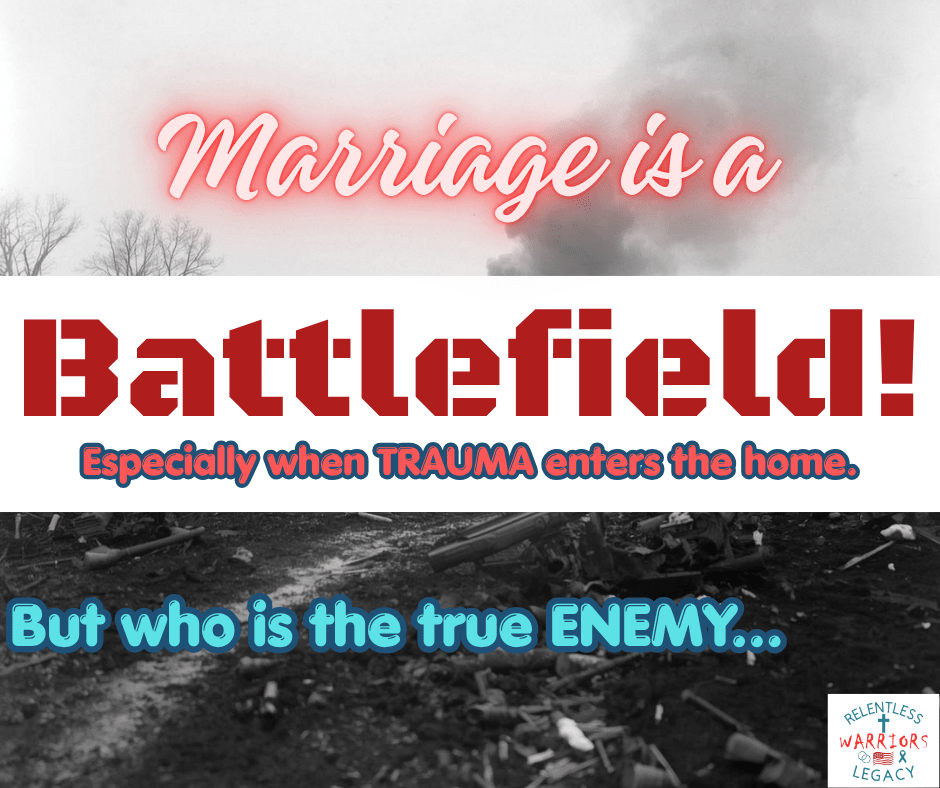
Fun history fact: World War I was the first war in which multiple modern weapons were used together on a large scale—machine guns and rifles, landmines, and barbed wire.
Imagine what that battlefield looked like. Bullets flying constantly, with no way to stop them. Watching every step so you don’t trigger a landmine. Then running into a wall of barbed wire that feels impossible to cross, leaving little hope of advancing against the enemy.
What do you think it felt like to stand on that battlefield? I imagine it felt hopeless and exhausting. It probably felt impossible to even begin the fight—let alone win it.
Now imagine your marriage looking like that battlefield.
Bullets — Life’s everyday stressors: chores, kids’ activities, minor financial disagreements, work pressures, and all the little things your spouse does that slowly start to irritate you. These are the constant, daily hits.
Landmines — The things you try to avoid, but they appear out of nowhere: the death of a loved one, car trouble, job loss, a broken appliance, or illness. They don’t happen every day, but when they do, they can trigger a chain reaction of stress in every area of life.
Barbed Wire — Trauma. Things like PTSD, depression, anxiety, and addiction. These create walls that feel impossible to climb over or break through.
Is this what your marriage looks and feels like?
And where is your spouse on this battlefield? Are they standing beside you—fighting on the same side against the real enemy? Or are they across from you, and the two of you are fighting each other instead?
Most of us place our spouse on the other side of the battlefield and begin to see them as the enemy. But what if there were a better way to fight?
It starts with you and your spouse standing side by side—as battle buddies. Together, you face the bullets, the landmines, and the barbed wire. The enemy is still throwing everything it has at you, but now you’re no longer fighting alone—you’re fighting together.
Let’s take it a step further.
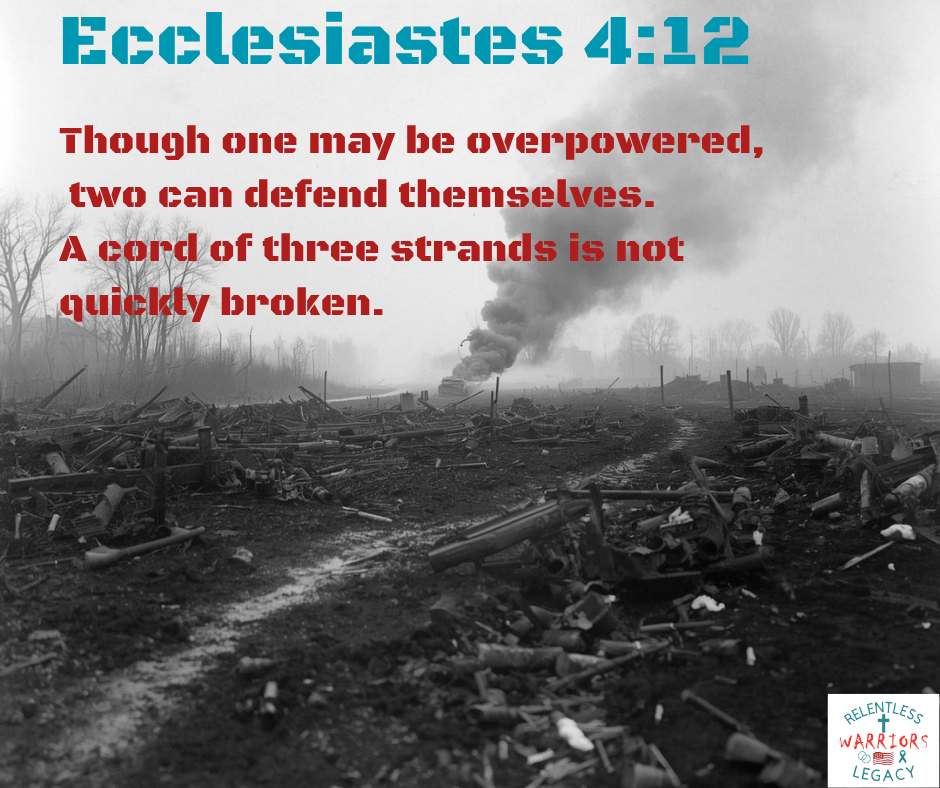
What if you invited God into that battle with you? As Scripture says, “Though one may be overpowered, two can defend themselves. A cord of three strands is not quickly broken.” — Ecclesiastes 4:12
God forms that third strand—creating a cord that is not easily broken. This means your marriage is stronger with Him than it could ever be without Him.
When I picture this, I see my husband and me standing hand in hand on that battlefield, with everything coming against us. And where is God?
He is the shield in front of us—protecting us. He is also fighting on our behalf, pushing back the enemy in ways we never could on our own.
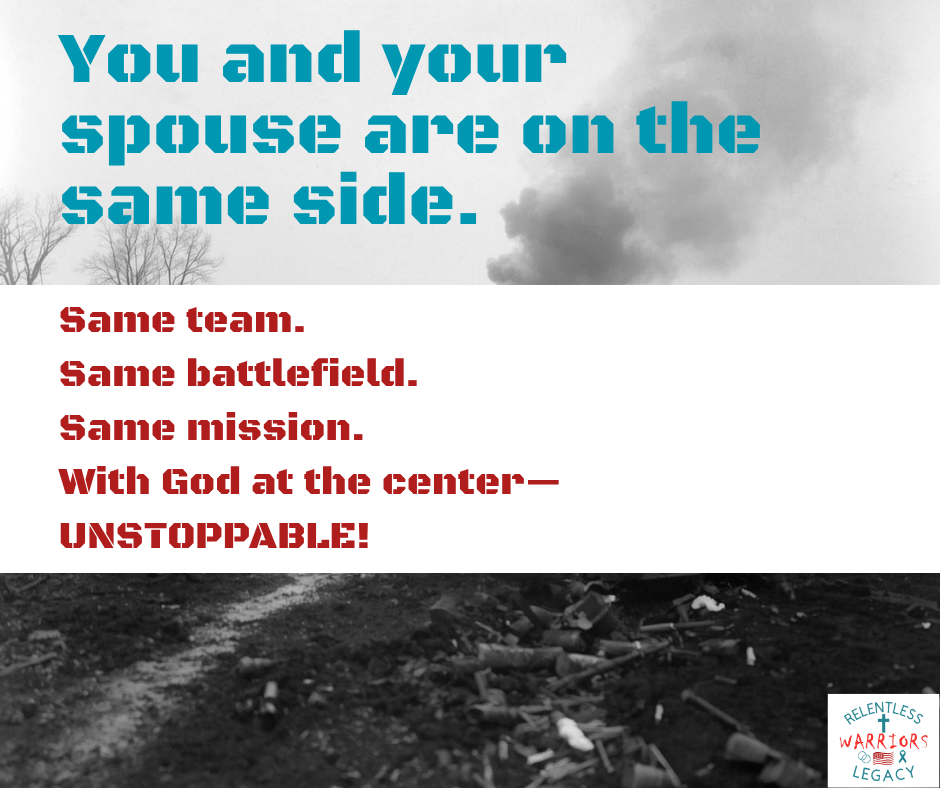
Same team.
Same battlefield.
Same mission.
With God at the center—
UNSTOPPABLE!
This battle becomes even harder when PTSD enters the marriage—and the home.
There were many times when I could not see Larry and me as being on the same team. We would scream and yell at each other, yet none of our problems were ever truly resolved. It became the same battle, over and over again, for 17 long years of marriage.
Unfortunately, we turned our home into a battlefield, with our children watching from the sidelines as spectators.
The true enemy is Satan, and he will use anything he can to come between a husband and wife. He especially loves when something like PTSD enters a marriage because it gives him more weapons to use—bullets, landmines, and barbed wire designed to divide two people from one another.
Satan seeks to destroy the bond between a husband and wife because when that bond is broken, it creates chaos within the entire family.
Want to know the secret to making sure you and your spouse stay on the same side of the battlefield? Communication.
You both have to learn how to truly communicate with each other—and with everyone living in your household.
Larry and I began with the Speaker/Listener technique. This was the beginning of saving our marriage because it opened lines of communication that had never existed between us before.
One of the biggest tools that helped Larry and I learn how to communicate was the Speaker/Listener technique. It sounds simple, but when emotions are high and difficult topics come up, this tool can completely change the direction of a conversation.
The way it works is this: one person holds an object. It can be anything—a pen, a small pillow, a coffee mug, or whatever you choose. The person holding the object is the only one allowed to speak. The other person’s job is not to interrupt, defend themselves, fix the problem, or prepare their next response. Their job is to truly listen.
When the speaker is finished, the listener repeats back what they heard to make sure they understood correctly. This is important because so many times we hear words through our own hurt, anger, or frustration instead of hearing what our spouse is actually trying to say. Once the speaker feels heard and understood, they pass the object to the other person so they can speak.
This technique slows conversations down and helps keep arguments from turning into attacks. It creates a safe space where both people can express feelings without being cut off, yelled over, or dismissed. It also helps couples stay focused on understanding each other instead of trying to “win” the conversation.
For Larry and I, this communication tool became one of the first steps toward healing our marriage. It opened the door to conversations we had avoided for years and helped us finally start hearing each other instead of just reacting to each other. It put us on the same side of the battlefield, fighting the enemy together!
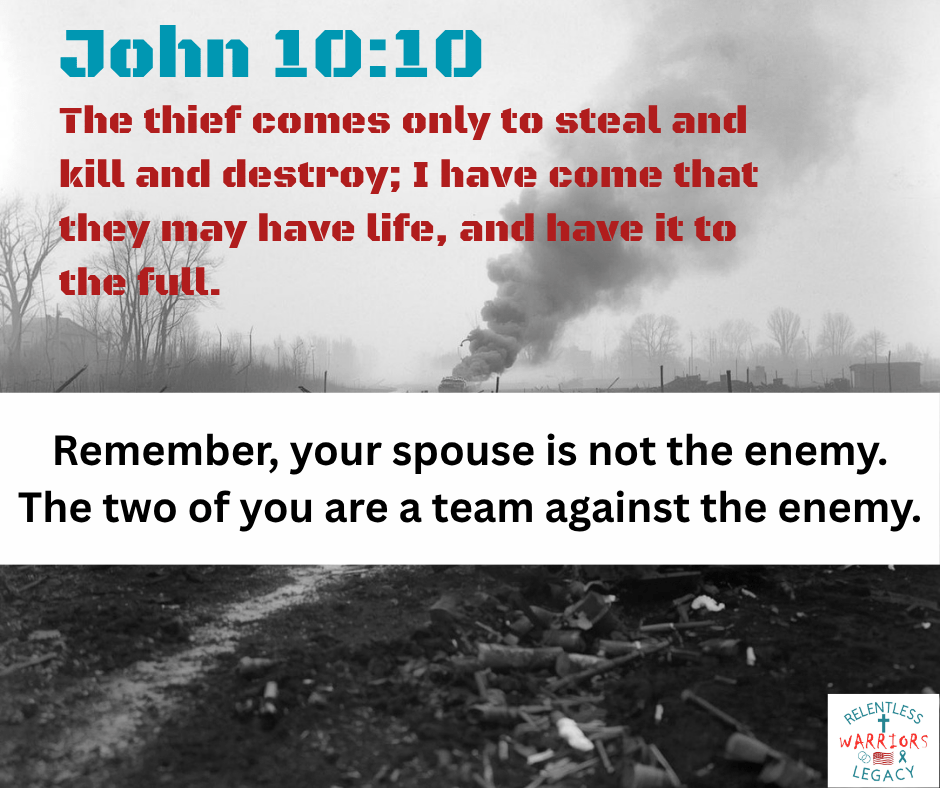
So remember, even when something like PTSD enters your marriage, you and your spouse are still on the same side. The two of you are not enemies.
You can fight stronger together when God is at the center of your marriage, helping guide and strengthen both of you. There will always be arguments and difficult moments, but the key is learning how to handle them when tension is high and emotions feel out of control.
The Speaker/Listener technique is a great place to start!
For any questions, please reach out to Larry and me at relentlesswarriorslegacy@gmail.com
Welcome back warriors!! We are now into February, and this is known as the month of love!
Melissa here to open up this month’s topic with you.
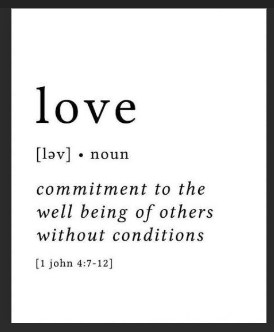
“Love” is our topic this month. Let’s start with the definition of Love. Love is 1.) an intense feeling of deep affection, 2.) a great interest and pleasure in something, 3.) a person or thing that one loves, 4.) feel deep affection for (someone), and 5.) like or enjoy very much.
WOW!! There are a lot of things that define Love. The definition of love lists several very positive things and things that make a person feel good. Everyone on this earth wants to feel love sometime in their lives. I am not sure what person does not want to feel butterflies at some point. I know I did when I met Lawrence.
There is one person that loves you unconditionally, no matter what. That is God the Father. He loves us no matter what we have done or said. God loves us no matter how far away we stray from Him. Hard thing to imagine right?? We get told by those on this earth that we are too much and completely unlovable, but God says otherwise.
Love does not always bring on those positive feeling that the definition describes. I will talk about my experience with Love on here in a few weeks. It has not always been a positive one. The part that the definition of love does not cover is how much hurt and heartbreak love on this earth can cause. We are going to dive into that. We are also going to look into how PTSD can cast a big shadow over love and how it is given and received. Mental health can make it to where no matter how much you love a person, they just cannot see it.
So, I hope you will join us through the month of February as we dive into LOVE and all that can bring.
Thank you for joining us today. Please Like, Share, and give us a comment or two! It can really help us out!
All through January we have talked about Faith and Prayer and the experiences that Lawrence and I have had with both of them. I believe everyone struggles with faith and prayer sometime in their lives. I can’t see how a person wouldn’t.
For me personally, the journey I have had with faith was hard. It took me a lot of time and digging into the Word to find the kind of faith I always wanted. Prayer on the other hand, was something that felt natural. I just believed that prayers for myself were not answered, only those for others. I had to see God really show up for me for those thoughts to change. God knew that though. There had to be a change in me mentally when it came to all the grief, sadness and anger I carried and there has been. As of today, I can proudly say that the mental change is still happening. I am still growing and healing. Growing my faith has changed my life. It has brought a peace and hope that I have never experienced before and because of that, my prayer life is better too.
Lawrence had a different walk than I did. He had faith until he felt like he had no way out with his PTSD. It was hard for him to see any kind of light at the end of the tunnel he was in. That caused him to lose faith. He also told you that his prayer life is not where he wants it to be. It is something he is working on. The more he grows his prayer life, the stronger his faith is becoming again.
One of the best quotes I have seen about faith and prayer is this, “Faith and Prayer are both invisible but they make impossible things possible.” That is the truth. Both of these are the things that will change your life if you let it. Another great quote is “Prayer is the key to Heaven but Faith unlocks the Door”. These two things can carry you though any situation. They bring hope even in the darkest places.
What do you have to lose?? If you are at rock bottom, try praying and having a little bit of faith to get you through!
Thank you for joining us today. Next week we will start our month of LOVE!! Please Like and Share out blog. Also come find us on Instagram and Facebook!





 Relentless Warrior's Legacy