


We have a few more weeks of talking about communication. There is a lot to cover when we look at how we speak and listen to one another. This week we are looking at the Awareness Wheel. This goes hand and hand with the Listening Cycle that we talked about last week. It is another effective tool to use when communicating to another person in a healthy manner. You can find all kinds of blank wheels. My advice is that you print one out and make a few copies to physically write it out a few times. This is a strategy that needs to be practiced. It will not come natural.
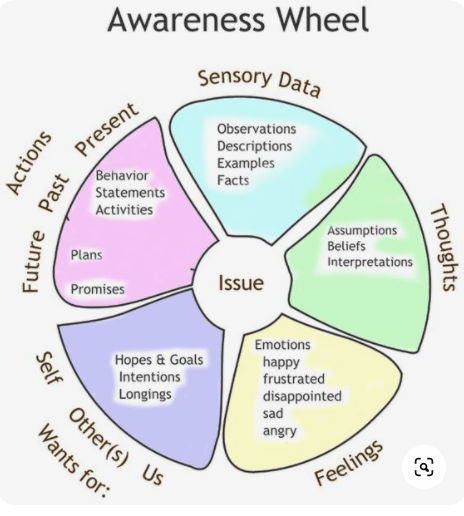
The first space we are going to start at on the wheel is the Issue. What is the problem we are looking at? The example we are going to use in this post is of a messy garage. A husband walks out into the garage and it is a hot mess. (yes I know that normally it would be the wife complaining about a messy garage but bare with me.) The first thing you must do is tell the other person what the issue is.
The next space on the wheel that you will go to is the Sensory Data part. In this section you want to be very descriptive. Lets look at the husband in our example. He is going to tell his wife that he can see the garage is messy. Now he is going to describe the mess. He can tell her that he can see bags of clothes out there that need to be donated. There is lots of empty boxes that need to be thrown away. Tools are sitting everywhere and not in their spots. Be as detailed as possible.
In the next section, you will state your Thoughts. This comes in the form of beliefs and interpretations. In this section the husband might say things like “there is no room to park cars” or ” I believe you are not putting the tools back where they go”. Remember this though, just because a person has a belief or observation, it does not make that person right. Everyone sees things differently.
This next section can be hard. It is the Feelings section. This is where you have to dig deep especially if it is a serious issue. Remember that anger is a secondary emotion and there is always something deeper when it comes to anger. This is where the husband will tell the wife how he feels about the state of the garage. The garage makes him feel anxious and confined. It makes him feel disrespected because he likes to have that space for himself. The husband might be disappointed because he had the garage clean and now it is a mess. These are all things that the husband is genuinely feeling and they must not be downplayed or cast aside. He is owning his emotions. Owning and admitting emotions can be a heard thing to do.
The Wants section can be pretty easy. What do you want for yourself, the other person, and the two of you together? What is the hope for the outcome of the situation? What goals can be set? We all have wants and goals for things. Now we get to state them. The husband can tell the wife that he wants to be able to find his tools. He hopes that she can be more organized. He would love it if they could both park in the garage. These are all goals that can be looked at and talked about.
Finally, we can look at the Actions that were and can be taken. This is divided into looking at past, present and future actions. You get to find a solution to the problem. Look at how this issue was handled in the past. Obviously, how the wife was doing things in the garage was not helping keep it clean but maybe the husband was not helping much either. Those actions have gotten them to their present issue. Now we can look toward what the future can hold for this garage. The husband might suggest a bin to put the tools in and then every month him or the wife can go put them all where they belong. The wife can make it a priority to take the unwanted clothes to the donation place as soon as she is done purging. They both can make sure that the boxes are making it out on trash day. These are all great solutions that they both played an active roll in coming up with.
All of theses sections of the Awareness Wheel can be done without all the yelling and blaming. The wheel drives the conversation and keeps things right on track. You are only looking at the issue in the center of the wheel and nothing else.
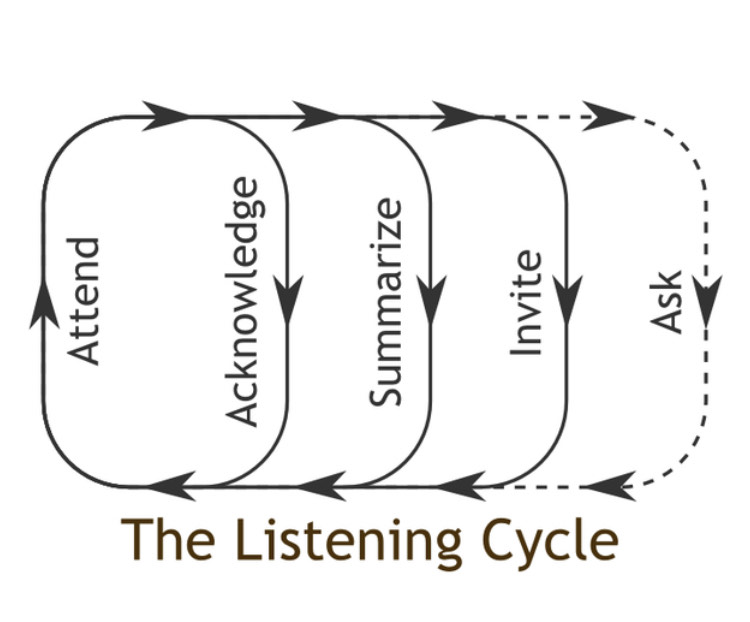
The Listening Cycle goes hand in hand with the Awareness Wheel. In the garage issue the wife is going through the Listening Cycle while the husband is going through the Awareness Wheel. Each is speaking and listening and the tools they are using are moving the conversation forward. If they stick to their action plan, then the issue will not come up again.
Thank you for joining us today. Next week we will be looking at labeling emotions. That is something that people with PTSD have problems doing. Please Like, Share, Comment, and Subscribe. Also find us on Facebook and Instagram under Relentless Warriors Legacy.
Ephesians 4:25 ESV Therefore, having put away falsehood, let each one of you speak the truth with his neighbor, for we are members one of another.
Melissa McGuire
(Relentless)
;IGY6
 Relentless Warrior's Legacy